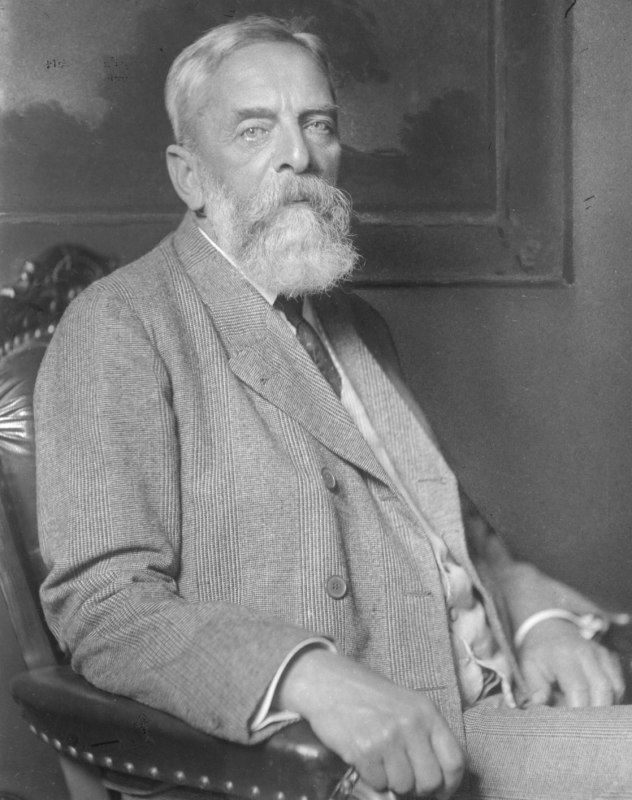
Subjectivist of Austrian Economics
Friedrich von Wieser was born on July 10, 1851, in Vienna, Austria. An influential economist of the Austrian School, he was a student of Carl Menger and played a significant role in the development of marginal utility theory and the concept of opportunity cost. Wieser’s academic journey began at the University of Vienna, where he studied economics and law, eventually becoming a prominent figure in economic thought.
Wieser’s most notable contributions to economics include his works on subjective value and the notion of opportunity cost. In his seminal book, The Theory of Social Economy (1889), he expanded upon Menger’s ideas, emphasizing that value is determined by individual preferences and the utility derived from goods. Wieser argued that economic decisions are based on subjective valuations rather than objective costs, underscoring the importance of individual choice in determining value.
One of Wieser’s key innovations was his articulation of opportunity cost, the concept that the true cost of any choice is the value of the next best alternative foregone. This idea became foundational in economic theory, providing a framework for understanding trade-offs in decision-making and resource allocation. Wieser’s formulation of opportunity cost has since become a central principle in both microeconomic and macroeconomic analysis.
In addition to value and cost theory, Wieser contributed to discussions on capital and production. He explored the relationship between land, labor, and capital, arguing that all production processes involve trade-offs among these factors. His insights laid the groundwork for later developments in production theory and the role of factors of production in economic growth.
Wieser was also active in academia, serving as a professor at the University of Vienna and later at the University of Prague. His academic influence extended to mentoring future economists, including some who would contribute significantly to the Austrian School. He continued to write and lecture on economic topics until his death on July 22, 1926.
Wieser’s legacy endures as a pivotal figure in the Austrian School, particularly for his advancements in subjective value theory, opportunity cost, and production analysis. His contributions have had a lasting impact on economic thought, shaping the understanding of individual choice and the nature of economic decision-making.
 The Economic Vanguard