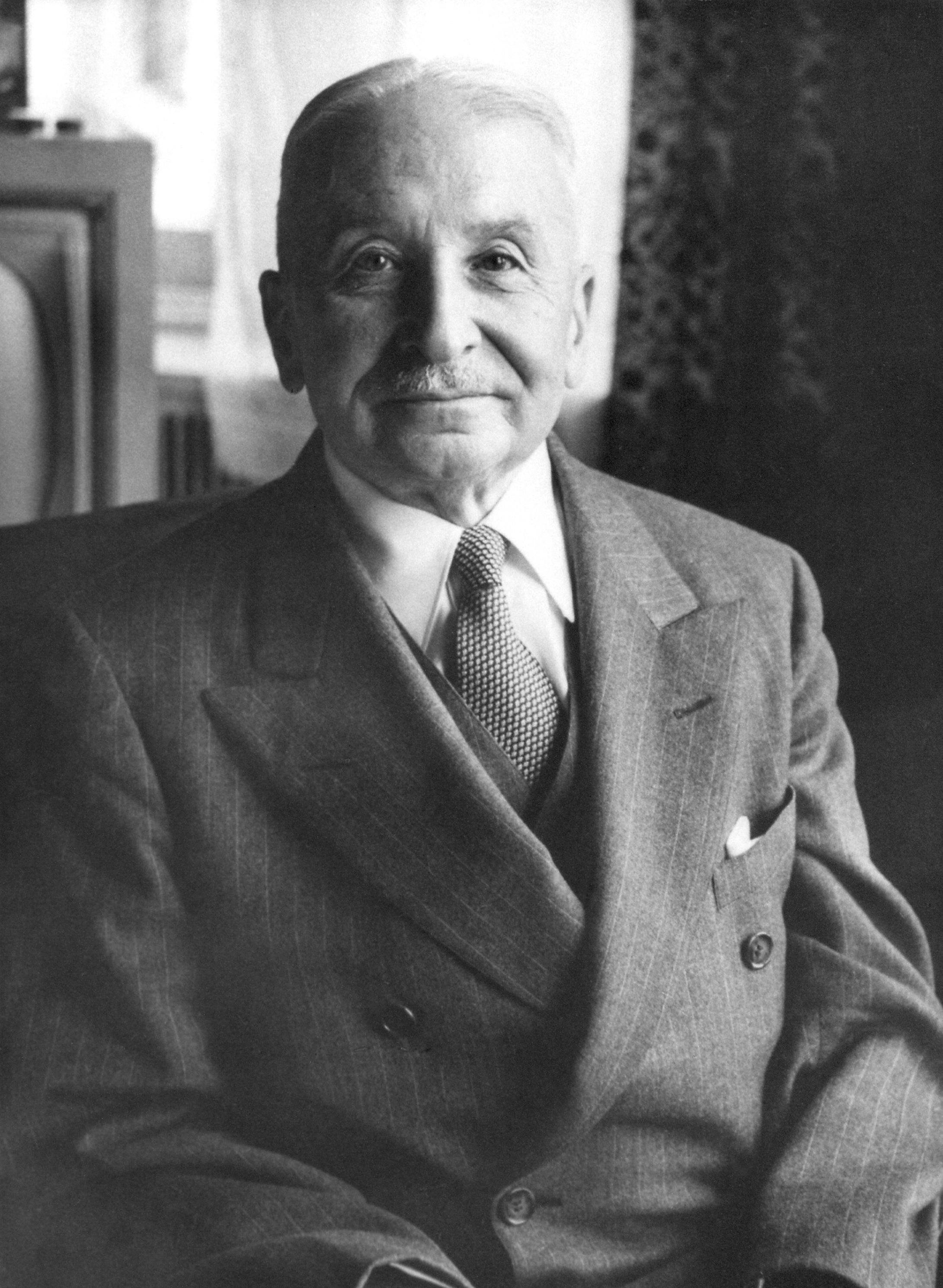
Architect of Austrian Economics
Ludwig von Mises was born on September 29, 1881, in Lemberg, Galicia (now Lviv, Ukraine), and is regarded as one of the most influential economists of the 20th century and a leading figure in the Austrian School of Economics. He studied law and economics at the University of Lemberg, where he was exposed to the ideas of Carl Menger and the early Austrian economists. Mises’s work would go on to redefine economic theory and solidify the Austrian School’s intellectual legacy.
Mises’s most significant contributions to economics include his comprehensive development of praxeology, the study of human action, which he articulated in his seminal work, Human Action (1949). He argued that economics should focus on understanding the decision-making processes of individuals, emphasizing the importance of subjective value and the role of human choice in shaping economic phenomena. This departure from the objective measurements of classical economics established a foundation for Austrian economics that remains relevant today.
A key element of Mises’s theory is his critique of socialism, which he detailed in Socialism: An Economic and Sociological Analysis (1922). He argued that socialist systems lack a rational economic calculation because the absence of market prices makes it impossible to determine the value of resources efficiently. Mises’s analysis highlighted the inevitable failures of centrally planned economies, reinforcing the necessity of free markets and individual entrepreneurship for economic prosperity.
In addition to his critiques of socialism, Mises made significant contributions to the understanding of money and business cycles. In The Theory of Money and Credit (1912), he explored the nature of money, credit, and the role of banking in the economy. He introduced the concept of monetary policy’s influence on economic cycles, which later influenced the development of Austrian business cycle theory. His insights into the relationship between credit expansion and economic instability have become a cornerstone of Austrian economics.
Throughout his career, Mises was an ardent advocate for classical liberalism, emphasizing the importance of individual liberty and free-market capitalism. He faced significant challenges during his life, including fleeing Austria in 1934 due to the rise of Nazism and eventually settling in the United States. There, he continued to write, teach, and promote Austrian economics through various institutions, including New York University.
Mises passed away on October 10, 1973, in New York City. His legacy endures as one of the foremost theorists of Austrian economics, and his works continue to be influential in discussions of individual choice, economic calculation, and the role of government in the economy. Mises’s ideas have inspired generations of economists and libertarians, ensuring his position as a central figure in the Austrian tradition.
 The Economic Vanguard