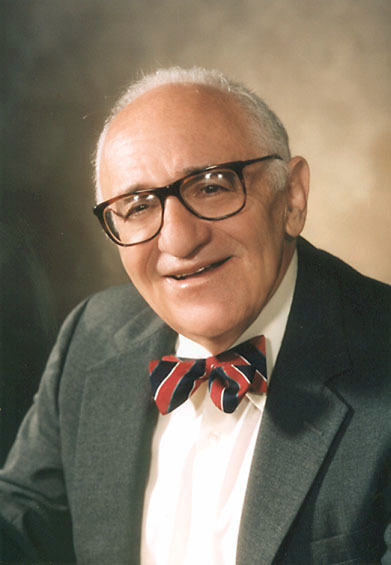
Liberator of Austrian Economics
Murray Rothbard was born on March 2, 1926, in New York City, USA, and is widely recognized as one of the most influential figures in the development of libertarian thought and the Austrian School of Economics. Rothbard’s intellectual journey began at Columbia University, where he studied economics under the guidance of notable economists, including Arthur Burns and George Stigler. He was profoundly influenced by the works of Ludwig von Mises, whose ideas shaped Rothbard’s approach to economics and politics.
Rothbard’s most significant contributions to economics and political philosophy include his development of a comprehensive framework for anarcho-capitalism, a political ideology advocating for a stateless society based on free markets and voluntary cooperation. In his seminal work, Man, Economy, and State (1962), Rothbard systematically presented the principles of praxeology and the implications of a free-market economy, arguing that all economic activity should be voluntary and free from government intervention.
One of Rothbard’s key concepts is the idea of self-ownership and the non-aggression principle. He posited that individuals have the right to own themselves and the fruits of their labor, asserting that any aggression against others’ property or rights is unjustifiable. This moral framework became a cornerstone of libertarian philosophy, influencing generations of activists and theorists who advocate for individual liberty and limited government.
In addition to his theoretical work, Rothbard extensively critiqued government intervention in the economy. His book Power and Market (1970) provided a detailed analysis of how government actions distort market processes and lead to inefficiencies and social unrest. Rothbard argued that state intervention not only disrupts voluntary exchanges but also generates unintended consequences that harm the very populations such policies are intended to help.
Rothbard was also known for his historical analyses, particularly regarding the role of the Federal Reserve and monetary policy in creating economic cycles. In his work, America’s Great Depression (1963), he examined the causes of the Great Depression, attributing it to government intervention and the inflationary policies of the Federal Reserve. His critiques of central banking continue to resonate within libertarian circles today.
Throughout his career, Rothbard was active in academia, holding teaching positions at various institutions, including Brooklyn Polytechnic Institute and New York University. He was a prolific writer, producing numerous books, articles, and essays that addressed a wide range of topics, from economics to political philosophy. Rothbard also co-founded the Cato Institute and later established the Mises Institute, dedicated to the promotion of Austrian economics and libertarian thought.
Murray Rothbard passed away on January 7, 1995, in Lake Jackson, Texas. His legacy endures as a foundational figure in libertarian economics and a prominent advocate for individual freedom and free-market principles. His writings continue to inspire economists, policymakers, and activists, solidifying his place as a key figure in the Austrian School of Economics and the broader libertarian movement.
 The Economic Vanguard