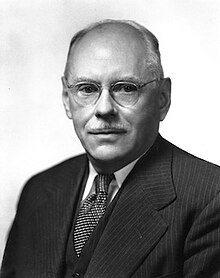
Profiteer of Chicago Economics
Frank H. Knight was born on November 7, 1885, in McLean County, Illinois. A key figure in the development of Chicago School economics, Knight made major contributions to the theory of risk, uncertainty, and entrepreneurship. His work laid the foundation for understanding how uncertainty affects economic decisions, and his emphasis on the role of entrepreneurship in driving economic progress helped shape the field of microeconomics and the theory of the firm. Knight’s Risk, Uncertainty, and Profit (1921) remains a seminal work in economic thought, influencing both future economists and the development of contemporary economic theory.
Knight earned his undergraduate degree from Baker University and went on to study at Columbia University, where he completed his Ph.D. in economics. His academic career took him to several institutions, but he is most famously associated with the University of Chicago, where he became a mentor to many influential economists. In his 1921 book Risk, Uncertainty, and Profit, Knight distinguished between risk, which can be quantified and managed through probability, and uncertainty, which cannot be predicted or measured. He argued that entrepreneurs, taking on uncertainty, are essential to the process of economic innovation and the creation of profits.
Knight was critical of the assumption of perfect competition and perfectly rational agents in classical economic theory, proposing instead that the world is inherently uncertain and that markets and firms are always dealing with a degree of unpredictability. This uncertainty, according to Knight, is a key source of economic profit, as entrepreneurs are rewarded for their ability to navigate the unknown.
Knight was also influential in the development of neoclassical economics, particularly through his integration of subjective value theory and marginalism into the analysis of entrepreneurship and profit. He played a pivotal role in shaping the economic policy and theoretical framework of the Chicago School, influencing economists such as Milton Friedman and George Stigler.
Knight’s work had a lasting impact on economic theory, especially in the areas of capital theory, market behavior, and the role of uncertainty in decision-making. He passed away on April 15, 1972, but his contributions to economic thought continue to be widely studied and applied, particularly in the fields of entrepreneurship and risk management.
 The Economic Vanguard