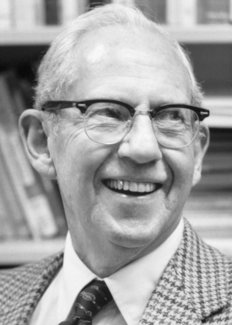
Competitor of Chicago Economics
George Stigler was born on January 17, 1911, in Renton, Washington. A leading figure in the Chicago School of Economics, he made groundbreaking contributions to the study of industrial organization, regulatory economics, and information theory. Stigler was instrumental in developing public choice theory, particularly in explaining how regulations often serve the interests of established businesses rather than the public. His work reshaped the understanding of market efficiency, competition, and government intervention, making him one of the most influential economists of the 20th century.
Stigler earned his undergraduate degree at the University of Washington, then pursued graduate studies at Northwestern University, before completing his Ph.D. at the University of Chicago under Frank Knight. After holding positions at several universities, he returned to the University of Chicago, where he became a key architect of its economic philosophy. His most significant contribution was in regulatory capture theory, which argues that government agencies often become dominated by the industries they are supposed to regulate, leading to policies that benefit businesses rather than consumers. This theory was outlined in his seminal 1971 paper, The Theory of Economic Regulation.
In addition to his regulatory insights, Stigler advanced the economics of information, arguing that imperfect information plays a crucial role in market outcomes. His 1961 paper, The Economics of Information, analyzed how consumers and firms gather and process information, laying the foundation for modern information economics. His work on competition and monopolies challenged traditional views, showing how firms use strategic behavior to maintain market power.
Stigler’s influence extended beyond academic research; he was a forceful advocate for deregulation and free markets, deeply shaping economic policy debates. In recognition of his contributions, he was awarded the Nobel Prize in Economic Sciences in 1982 for his work on market structures, regulation, and the role of information in economics. He remained an active scholar and a key figure in economic thought until his death on December 1, 1991, leaving behind a legacy of rigorous analysis and a commitment to free-market principles.
 The Economic Vanguard