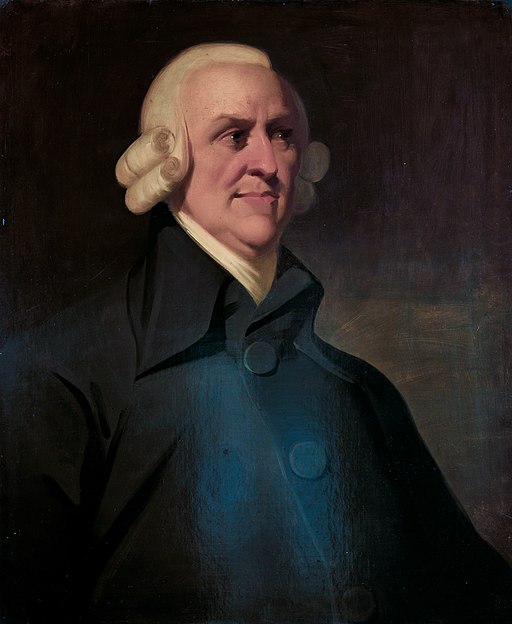
Father of Classical Economics
Adam Smith was born on June 5, 1723, in Kirkcaldy, Scotland. Raised by his widowed mother, he displayed remarkable intelligence from an early age. He studied at the University of Glasgow under the influential philosopher Francis Hutcheson before earning a scholarship to Balliol College, Oxford. However, he found Oxford’s education uninspiring compared to Glasgow’s intellectual atmosphere. Smith later became a professor of moral philosophy at the University of Glasgow, where he gained a reputation for his lectures on ethics, jurisprudence, and political economy. In 1764, he left academia to tutor the young Duke of Buccleuch, a position that funded his travels across Europe, where he encountered the French Physiocrats, whose emphasis on free trade greatly influenced his thinking.
In 1759, Smith published The Theory of Moral Sentiments, a philosophical work exploring the nature of human morality and sympathy. However, his most enduring contribution came in 1776 with An Inquiry into the Nature and Causes of the Wealth of Nations, which laid the foundation of Classical Economics. In this groundbreaking work, Smith argued that economic prosperity arises from free markets and the division of labor. His famous “invisible hand” metaphor described how individuals pursuing their own self-interest unintentionally benefit society. He advocated for laissez-faire economics, where government intervention should be minimal, limited only to national defense, law enforcement, and public works. He also rejected mercantilism, arguing that wealth is created through production and trade rather than hoarding gold and silver.
A key insight from Wealth of Nations was the division of labor, illustrated by Smith’s famous pin factory example, demonstrating how specialization increases productivity. He also introduced an early version of the labor theory of value, though he acknowledged the roles of supply and demand in pricing. His ideas shaped economic thought for centuries, influencing figures such as David Ricardo, John Stuart Mill, and even Karl Marx. Though Smith lived a modest life, focusing more on intellectual pursuits than personal wealth, his work revolutionized economics. He died in Edinburgh on July 17, 1790, leaving behind a legacy that continues to define modern economic thought.
 The Economic Vanguard