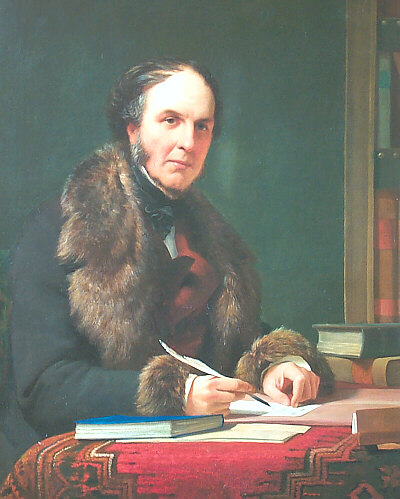
Defender of Classical Economics
Nassau William Senior was born on September 26, 1790, in Compton, England. Educated at Eton and Magdalen College, Oxford, he excelled in classics and mathematics before turning his attention to political economy and law. Senior became the first professor of political economy at Oxford in 1825, where he played a key role in formalizing Classical Economics. Though not as revolutionary as Adam Smith or David Ricardo, he was a staunch advocate of laissez-faire economics, contributing significantly to labor theory, capital accumulation, and monetary policy.
One of Senior’s most controversial contributions was his Wage-Fund Doctrine, which argued that wages are determined by a fixed fund of capital set aside by employers. According to this theory, increasing wages without increasing capital investment would reduce the number of workers that could be employed. This idea, used to oppose labor unions and minimum wage laws, was widely accepted in early economics but later challenged by John Stuart Mill and Karl Marx, who argued that wages were more flexible and influenced by bargaining power.
Senior was also instrumental in refining Ricardian capital theory. He emphasized that capital accumulation is essential for economic progress and that interest rates were a reward for abstaining from immediate consumption. He introduced the idea that profit is not just a return on risk but also on abstinence, suggesting that capitalists deserved compensation for delaying gratification—a notion that foreshadowed later discussions on time preference and interest rates in economic theory.
Beyond theoretical contributions, Senior played a key role in British economic policy. As an advisor to the government during the Irish Famine (1845–1852), he controversially argued against excessive state intervention, believing that market forces should correct food shortages, a stance criticized for its insensitivity to human suffering. He was also involved in debates on poor laws and workhouse conditions, advocating for policies that discouraged dependence on state aid.
His work on monetary policy and international trade further solidified his reputation as a defender of classical liberalism. Senior was a strong supporter of free trade, arguing that protectionist policies harmed long-term economic development. His monetary theories contributed to discussions on inflation and banking, influencing the eventual adoption of the Bank Charter Act of 1844, which sought to regulate paper currency issuance.
Though Senior’s ideas were later challenged and revised, his staunch defense of laissez-faire economics, capital accumulation, and free trade helped shape British economic policy in the 19th century. He died on June 4, 1864, leaving behind a legacy as a dedicated economist, policy advisor, and proponent of classical economic thought.
 The Economic Vanguard