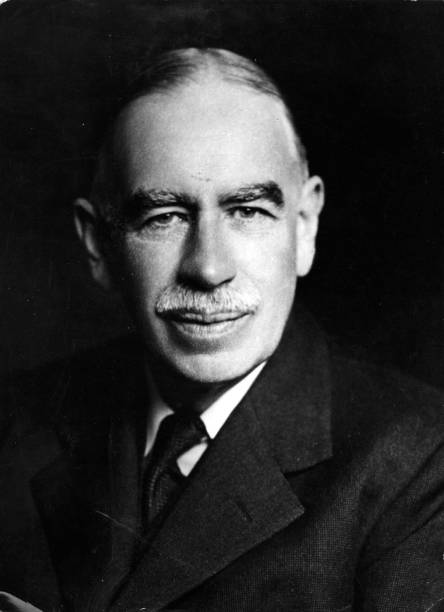
Founder of Keynesian Economics
John Maynard Keynes was born on June 5, 1883, in Cambridge, England. He was the son of John Neville Keynes, an economist and lecturer at the University of Cambridge, which fostered an environment rich in intellectual pursuits. Keynes attended Eton College and later studied at King’s College, Cambridge, where he became involved in the university’s economics faculty. His academic career at Cambridge was distinguished; he became a fellow of King’s College and was influenced by prominent economists, including Alfred Marshall.
Keynes is best known for his foundational contributions to macroeconomics, particularly through his seminal work, “The General Theory of Employment, Interest, and Money,” published in 1936. In this work, he challenged classical economic theories and introduced several key concepts that revolutionized economic thought. He emphasized the importance of effective demand, arguing that total spending in the economy drives economic activity and employment levels. Additionally, Keynes formulated the multiplier effect, demonstrating how an initial increase in spending could lead to a larger overall increase in national income. His concept of liquidity preference explained how individuals prefer to hold liquid assets, affecting interest rates and investment decisions.
Throughout his career, Keynes wrote several influential works, including “A Treatise on Money” (1930) and “The Economic Consequences of the Peace” (1920). The latter examined the economic implications of the Treaty of Versailles and argued against excessive reparations imposed on Germany, warning that such measures could lead to future instability.
Keynes advocated for government intervention in the economy, positing that active fiscal policies could mitigate the adverse effects of economic downturns. His ideas gained prominence during the Great Depression, shaping economic policy in the United States and Europe.
John Maynard Keynes passed away on April 21, 1946, in Firle, England. His contributions to economic theory laid the groundwork for Keynesian economics, profoundly influencing economic policies and debates in the years that followed, and his legacy continues to resonate in contemporary economic thought.
 The Economic Vanguard