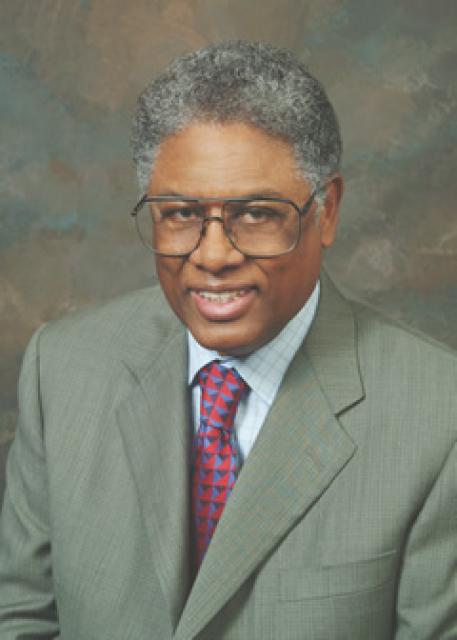
Living Stalwart of Chicago Economics
Thomas Sowell was born on June 30, 1930, in North Carolina, USA. Sowell’s academic journey began with a Bachelor of Arts in Economics from Harvard University in 1958, followed by a Master of Arts in Economics from Columbia University in 1959, and later, a Doctorate in Economics from the University of Chicago in 1968. His studies and intellectual development were influenced heavily by the academic rigor of these institutions, particularly Chicago, where he was exposed to free-market economics and the empirical approach that would come to define much of his career.
Sowell’s professional life spans decades, with tenure at notable academic institutions, including Cornell University, Rutgers University, and University of California, Los Angeles (UCLA). He is perhaps best known for his work as a Senior Fellow at the Hoover Institution at Stanford University, where he contributed substantially to research on political economy, race, and social issues. Sowell’s academic career helped cement his reputation as a staunch advocate for free markets, limited government, and individual liberty—positions that align with the Chicago School of economics and classical liberalism.
Throughout his career, Sowell’s research has been driven by an emphasis on empirical data and real-world examples, challenging conventional wisdom on topics ranging from economic policy to race relations. A central tenet of Sowell’s work is the belief that government intervention often has unintended consequences that hinder, rather than help, the very groups it aims to assist. In books like “Basic Economics”, Sowell effectively explains economic principles in a way that is accessible to the general public, emphasizing incentives and market forces over government solutions. His critique of welfare programs, affirmative action, and redistribution policies is grounded in his belief that these measures often create dependency and stifle economic mobility, particularly among disadvantaged communities.
Sowell has written a number of influential books, including “Basic Economics”, which simplifies complex economic concepts for a broad audience and explains the mechanics of markets, incentives, and trade-offs in a clear, accessible way. In “Discrimination and Disparities”, Sowell examines the causes of economic and social disparities between different groups, asserting that cultural and historical factors are more significant than discrimination in explaining these gaps. His “Black Rednecks and White Liberals” looks at the cultural forces shaping racial disparities, particularly in the context of African American history and the legacy of the American South, challenging conventional narratives about race and culture. “A Conflict of Visions” explores the clash between the “constrained vision”, which sees human nature as inherently flawed and advocates for limited government and market-driven solutions, and the “unconstrained vision”, which views human nature as perfectible and supports larger governmental interventions to shape society. In “The Vision of the Anointed”, Sowell critiques intellectual elites, asserting that their idealistic, top-down policies often ignore the practical realities faced by individuals, resulting in unintended negative consequences. “Intellectuals and Society” expands on this theme, highlighting the disconnection between the theories of intellectuals and the lived experiences of ordinary people, particularly in economic and social policy. In “Economic Facts and Fallacies”, Sowell debunks common economic misconceptions, exposing how many widely accepted beliefs about issues like housing, education, and welfare are rooted in false assumptions and misleading evidence. His work continues to challenge prevailing ideas in economics, particularly regarding the role of government intervention and the importance of individual responsibility and market solutions.
Sowell’s scholarship continues to shape discussions around economic policy, social justice, and racial issues, offering a rigorous critique of the role of government in these spheres. As of now, Thomas Sowell is still alive and remains a leading figure in economic thought, particularly within the realms of classical liberalism, free-market capitalism, and economic empiricism.
 The Economic Vanguard