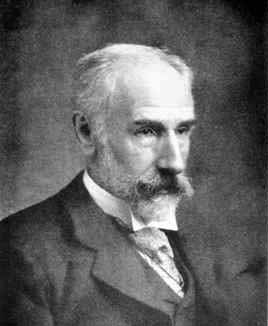
Equilibrist of NeoClassical Economics
Francis Ysidro Edgeworth was born on February 8, 1845, in Edgeworthstown, Ireland. He initially studied languages and philosophy at Trinity College Dublin and Balliol College, Oxford, before turning to economics, where he became one of the most influential mathematical economists of the late 19th and early 20th centuries.
Edgeworth is best known for his work in mathematical economics, utility theory, and statistical methods, which helped shape modern economic thought. In his major work, Mathematical Psychics (1881), he introduced the Edgeworth Box, a graphical representation used to analyze exchange and competitive equilibrium in two-person economies. This tool became fundamental in microeconomic and general equilibrium theory, helping to illustrate the gains from trade and efficient allocation of resources.
He also extended marginal utility theory, refining earlier ideas from Jevons and Walras. His contributions to indifference curve analysis laid the foundation for later developments in consumer choice theory. Edgeworth’s insights were instrumental in moving economics away from cardinal utility (measurable satisfaction) toward the more modern concept of ordinal utility, where consumers rank preferences rather than assign exact values to them.
In addition to microeconomics, Edgeworth made significant contributions to welfare economics. He introduced the contract curve, which represents the set of efficient allocations within an Edgeworth Box, illustrating how voluntary exchange can lead to mutually beneficial outcomes. His work directly influenced later economists, including John Hicks and Paul Samuelson, in their formalization of consumer behavior.
Edgeworth was also a pioneer in statistical methods in economics. His studies on probability theory and statistical inference helped advance early econometrics. He introduced Edgeworth’s Limit Theorem, which improved upon the central limit theorem and remains relevant in probability theory today.
Despite his brilliance, Edgeworth was known for his dense and highly mathematical writing style, which made his work difficult to access for many of his contemporaries. However, his influence grew as later economists built upon his ideas, particularly in game theory, contract theory, and market efficiency analysis.
Edgeworth served as editor of the Economic Journal from 1891 to 1926, where he played a crucial role in shaping the direction of economic research. He passed away on February 13, 1926, but his contributions to mathematical economics, utility theory, and statistical analysis remain central to the discipline today.
 The Economic Vanguard