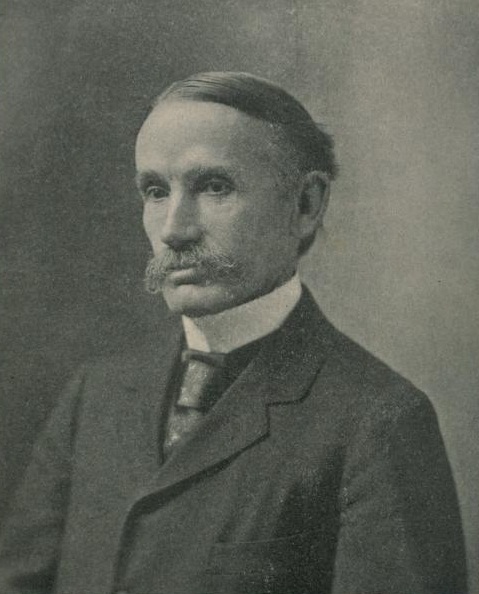
Marginalist of Neoclassical Economics
John Bates Clark was born on January 26, 1847, in Providence, Rhode Island. He initially studied at Brown University before continuing his education in Germany, where he was influenced by the works of the German Historical School. However, Clark later shifted toward neoclassical economics, becoming one of the most important American economists of the late 19th and early 20th centuries.
Clark’s most significant contribution to economics was the marginal productivity theory of distribution, which he developed in response to the growing debate over income distribution and social justice in capitalist economies. In his seminal work, The Distribution of Wealth (1899), he argued that wages, rent, and capital returns are determined by their respective marginal contributions to production. This idea became a cornerstone of neoclassical factor pricing theory and is still fundamental in modern labor and capital economics.
His marginal productivity theory refuted socialist claims that workers were being systematically exploited, asserting instead that under perfect competition, labor and capital receive compensation equivalent to their contributions to output. This provided a moral justification for capitalism, reinforcing the idea that free markets lead to fair outcomes when competitive forces are allowed to operate efficiently.
Clark also played a key role in shaping American economic thought. Unlike European neoclassicists who emphasized mathematical models, Clark’s approach was more intuitive and policy-driven, making his work accessible to policymakers and business leaders. His emphasis on capital accumulation and economic growth influenced later theories on investment and business cycles.
Beyond his theoretical contributions, Clark was a strong advocate for progressive economic policies. He believed that while free markets were generally fair, monopolies and market failures could distort income distribution, necessitating government intervention to ensure competition and economic justice. His later work addressed antitrust policy and economic reform, aligning him with the progressive movement in early 20th-century America.
Clark’s influence extended beyond his writings—he was a founding member of the American Economic Association (AEA) and played a central role in establishing economics as a formal academic discipline in the United States. The John Bates Clark Medal, awarded by the AEA to outstanding economists under the age of 40, is named in his honor and remains one of the most prestigious awards in the field.
Clark passed away on March 21, 1938, but his contributions to marginal productivity theory, income distribution, and the moral defense of capitalism continue to shape economic thought today.
 The Economic Vanguard