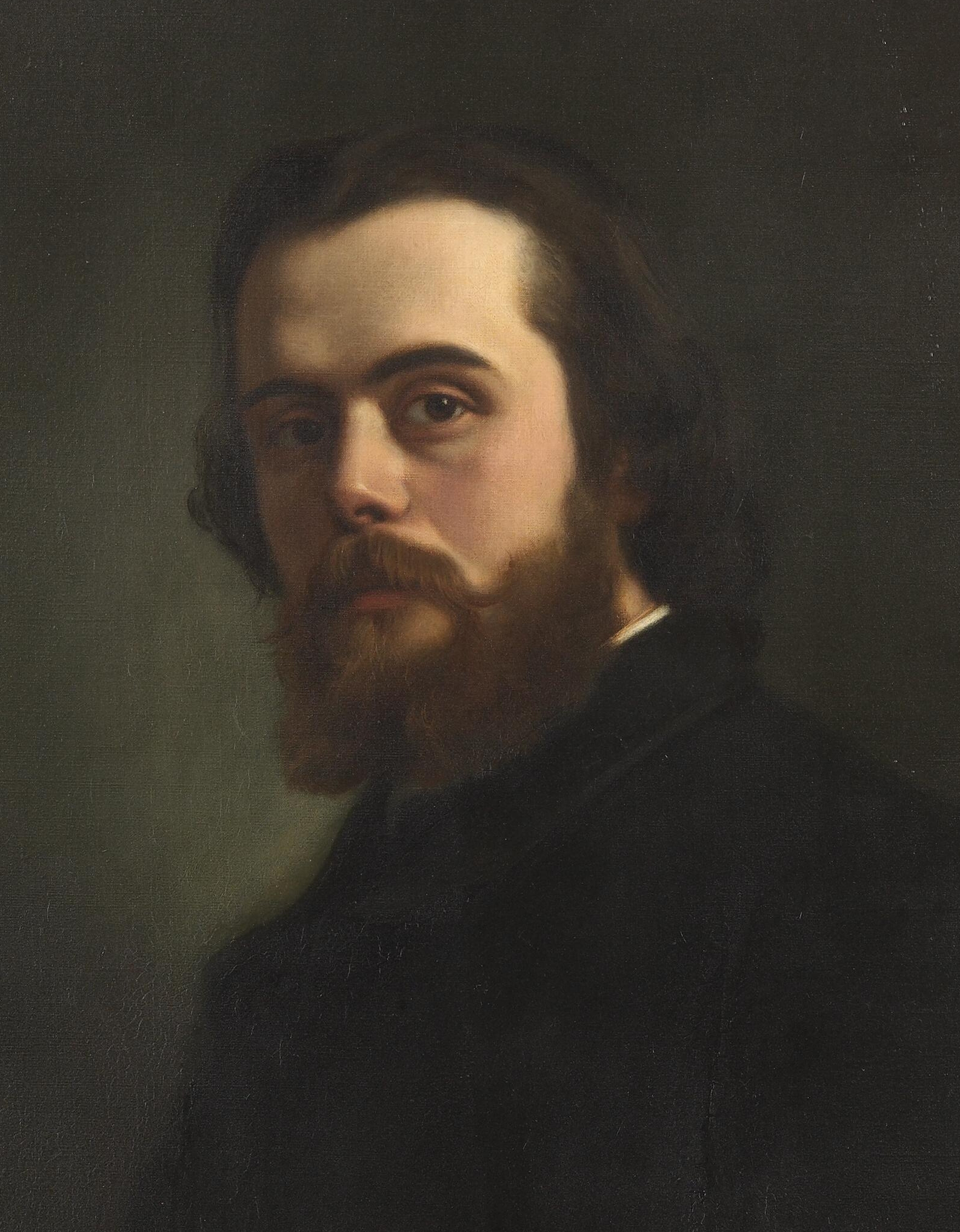
Pioneer of Neoclassical Economics
Léon Walras was born on December 16, 1834, in Évreux, France. The son of economist Auguste Walras, he initially pursued engineering but later shifted to economics under his father’s guidance. Walras would go on to become one of the most influential figures in neoclassical economics, particularly for his pioneering work in general equilibrium theory.
Walras’s most significant contribution to economics was his formulation of general equilibrium theory, presented in his seminal work Éléments d’économie politique pure (1874). This theory sought to demonstrate how multiple markets in an economy could simultaneously reach equilibrium through a system of interdependent equations. Unlike classical economists, who focused on individual markets in isolation, Walras introduced the idea that all markets are interconnected and must be analyzed as a whole.
Central to Walras’s framework was the Walrasian auctioneer, a hypothetical mechanism that adjusts prices until supply and demand across all markets are in balance. This concept laid the foundation for modern microeconomic theory and influenced later developments in mathematical economics.
Walras was also a key figure in the marginal revolution, alongside William Stanley Jevons and Carl Menger. He emphasized that prices are determined by marginal utility, or the additional satisfaction gained from consuming one more unit of a good, rather than by production costs alone.
Beyond general equilibrium, Walras contributed to theories of capital formation and monetary economics, arguing that money should be neutral in long-term economic equilibrium. His work anticipated later advancements in welfare economics, influencing economists like Kenneth Arrow and Gérard Debreu, who formalized general equilibrium theory in the 20th century.
Despite his intellectual contributions, Walras struggled to gain widespread recognition during his lifetime. His complex mathematical approach made his work difficult for contemporaries to grasp, and he spent much of his career as a professor at the University of Lausanne, where he influenced the development of the Lausanne School of Economics.
Walras passed away on January 5, 1910, but his contributions remain foundational to modern economic thought. His general equilibrium model continues to shape economic analysis, and his work bridged the gap between classical and modern economics, cementing his place as a key architect of neoclassical economics.
 The Economic Vanguard